How to Keep Your Strategic Plan From Gathering Dust

There are plenty of examples of strategic plans sitting on a shelf, quietly gathering dust. We understand why. Too often, the planning process is exhausting or confusing. The resulting plan can be unwieldy or unrealistic given available resources. Implementation is vague—responsibilities are unclear, timelines are fuzzy, and there are no meaningful ways to measure progress. Just as often, there’s no clear process for reviewing, updating, or adapting the plan over time.

The good news? All of these pitfalls are entirely avoidable.

A strong strategic plan doesn’t just guide growth—it drives continuous improvement. At its best, a plan is more than a static roadmap. It’s a dynamic framework that helps your organization respond thoughtfully to changing conditions and emerging opportunities, positioning you to thrive over the long term.

For us, effective strategic plans:

  • Integrate feedback from key customers, constituents, and clients

  • Are data-driven, well-researched, and grounded in reality

  • Focus on a small number of clearly prioritized goals

  • Include concrete, actionable strategies and tactics

  • Establish clear timelines and accountability for implementation

  • Define metrics to measure progress toward goals

  • Are reviewed regularly and adapted as conditions shift

When done well, strategic planning becomes a living practice—one that aligns people, sharpens focus, and turns intention into impact.

Smart and Nice: The Leadership Equation

I have two criteria for hiring: Are you smart? Are you nice?
Gail McGovern, Chair, American Red Cross

I worked for Gail McGovern. She knows leadership. Gail’s been Executive Vice President at AT&T, President of Fidelity Personal Investments, and co-chair of the Johns Hopkins Board of Trustees. Trained as a mathematician, she understands the importance of intelligence, skill, and performance. But she also insists on something equally vital — being nice.

We’ve all heard the saying: Half of any job is getting the work done. The other half is how it gets done. That’s easy to say and hard to live.

Workplace pressures — deadlines, budgets, politics, difficult personalities — can make “being nice” challenging. And yet, kindness and respect are exactly what hold teams together when things get tough.

I’ve had to make painful leadership decisions: layoffs, reorganizations, service cuts, firings. None of that felt nice to those on the receiving end. One boss told me I was too nice, and another told me I needed to be tougher. Striking the right balance isn’t a formula; it’s an ongoing practice shaped by culture, timing, and circumstance.

Being nice isn’t about being sweet, or even about personality; it’s about behavior. It’s about how you:

  • Listen and communicate.

  • Disagree respectfully.

  • Support colleagues and staff.

  • Acknowledge mistakes.

  • Say “thank you” and “I’m sorry.”

In the end, effective leadership requires both head and heart — intelligence that drives results, and kindness that sustains relationships.

Leadership is about being smart and being nice.

Let’s discuss how you bring both to your leadership.

Communicate Like Bridget

This is a critically important time to communicate with your supporters. But enough text-only emails. More videos like Bridget’s. More handwritten notes. More phone calls. 

I gave charitable gifts to ten organizations last year. In the month since Covid_19 has upended our lives, I’ve received updates from most of them by text-only email.

Bridget is executive director of an organization serving homeless youth. She founded the agency 15 years ago and is well-known to its volunteers, donors and partners. Bridget recently posted a video to supporters on YouTube. As a donor, I found her message powerful. Here are six reasons why:

It’s simple.  Her organization spent none of its limited money and time on a highly-produced video. She made notes, put her kids in the next room, turned on her camera, and spoke.

It’s authentic.  If you know Bridget, this is her – kind, thoughtful, committed and self-effacing. There’s no false bravado here, just a face and voice in an inbox flooded with text.

It’s personal.  She starts by telling us about her family, and empathizing with all of us lucky enough to be working from home with loved ones.

It’s informative.  Bridget gives us a practical update about her staff’s current work serving homeless youth, and their plans to continue helping youth even if things get worse.

It’s short.  Her message is just three minutes – long enough to be informative, and brief enough to keep me watching. 

It’s inspiring.  She asks for money, but only after I’ve seen her genuine caring, heard about the courage and commitment of her staff, and been reminded of the resilience of youth.  

This is a critically important time to communicate with your supporters. But enough text-only emails. More videos like Bridget’s. More handwritten notes. And more phone calls. 

What are your thoughts about communicating with your supporters during this time? 

Applying Equity in a Crisis

Now more than ever, applying an equity lens to leadership and decision-making is essential.

In times of crisis, it’s easy to stop or disregard diversity, equity and inclusion work as less relevant or an unnecessary luxury. But now more than ever, applying an equity lens to leadership and decision-making is essential.

Here are six ways you can apply an equity lens to your organization in times of crisis.

  1. Use Inclusive Communication. In a crisis, it’s easy to resort to ‘telling’ communication: “Leadership met; here’s where we are; here’s what you’re going to do.” An equity lens in communication means first asking and listening, and then responding. Ask what people are experiencing and needing. Listen to what people say without interrupting, explaining or telling. Respond by explicitly addressing people’s concerns in your follow-up communications.
  2. Honor Differences in Response. Different people, communities and cultures have different ways of handling stress and expressing emotion. An equity lens respects all responses, not just the ones we’ve historically deemed “professional.” Allow space for both the doomsday-predictors and deniers. Recognize the highly-distracted and hyper-focused. Acknowledge both the expressive emoters and stiff-upper-lippers.
  3. Coach on Working Remotely. Not everyone is comfortable with technology. Helping your team be successful in this environment takes more than, “Here’s the link to our Zoom meeting. Follow the instructions for downloading.” Coach your people on Technology 101, the etiquette of phone and video conferencing, and practical ways to be productive while working at home amid multiple distractions. Allow time for some people to process new ways of working virtually.
  4. Community Relations. We’ve all received them – the “Our Response to COVID-19” emails, many of which are generic in content. An equity lens means being transparent, clear and specific so that your constituents have the relevant information they need. Explain how you are caring for your people, which products, programs and services continue to be available, how you are handling your suppliers and vendors, and how and when you will continue to communicate.
  5. Reductions in Force. If reducing your workforce is necessary because of declining revenue, consider the economic situation of your employees, and explore the pros and cons of furloughs vs. lay-offs. Ask your employees about their situation and needs. Furloughs allow people to remain employed with reduced hours and access to benefits, and be quickly re-activated when business picks up again. Lay-offs sever the employment relationship, enabling people to seek unemployment.
  6. Paying Vendors and Suppliers. When making decisions about paying vendors when revenue gets tight, consider the financial capacity of smaller businesses to weather financial storms. While striving to honor your commitments and being fair to everyone, an equity lens recognizes the possible differential impact on some businesses. Pay attention to under-represented groups such as women-, minority-, veteran-, disability-owned and emerging small businesses.

What are your thoughts and experiences of applying an equity lens to your organization in a crisis?

Thomas Bruner, Bruner Strategies and Lillian Tsai, TsaiComms

Year-End Appeals: My Client Got It Right

Year-End Appeals: My Client Got It Right

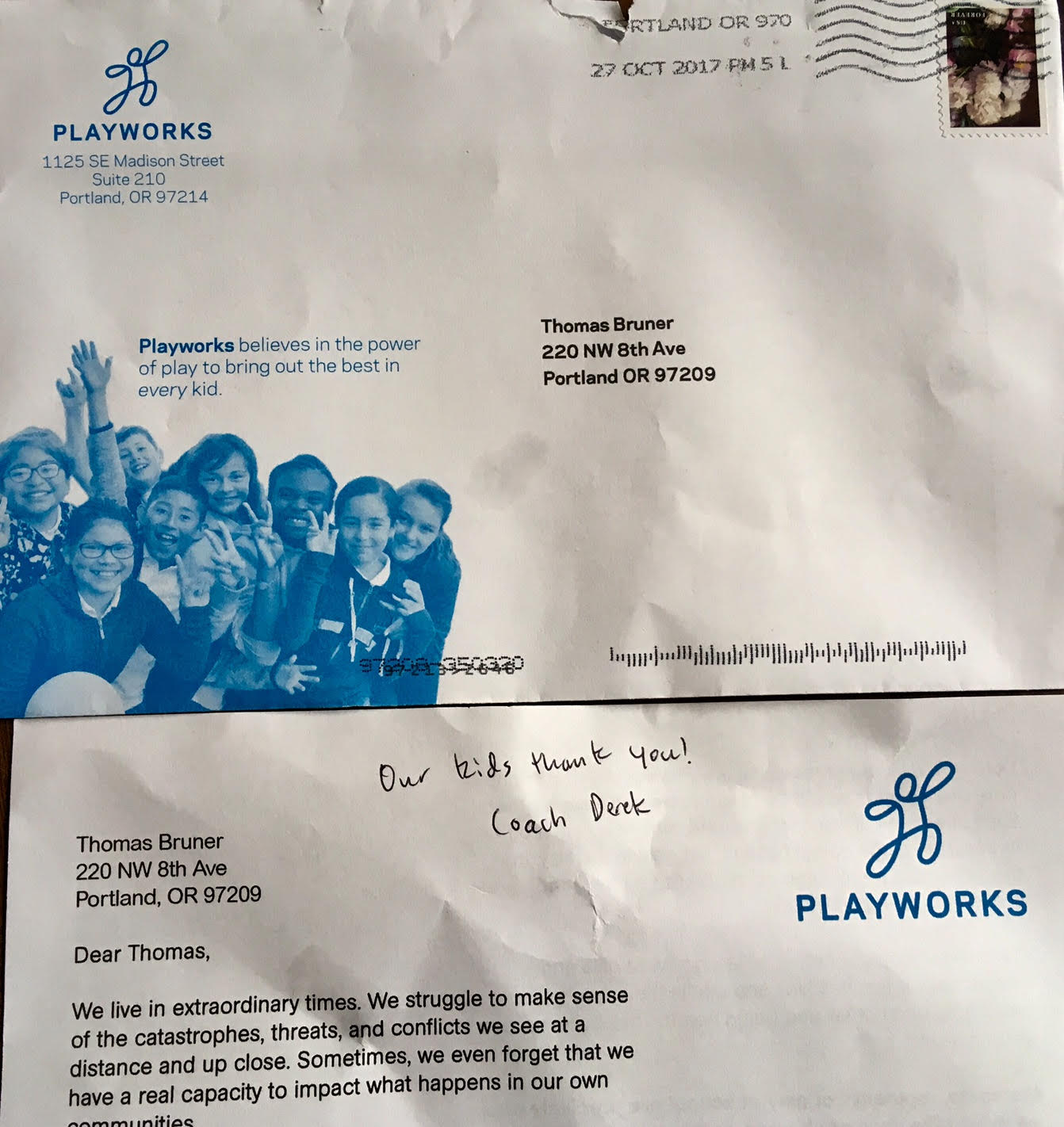
I received a year-end fundraising letter on October 30 from one of my clients, Playworks Pacific Northwest. While simple and produced on a budget, it stood out for following evidence-based practices for soliciting end-of-year gifts by mail.

Effective year-end mailings don’t have to be complicated or expensive. But they do need to be thoughtful and well-coordinated. Here are the simple but important things that Playworks got right.

  • Received before the holiday rush. They got on my year-end gift list early – October 30.
  • Name/address printed on the envelope (no mailing labels). Helps me feel less like one of thousands.
  • Bulk mail stamp (no pre-printed indicia). Looks less institutional and more personal.
  • Off-size envelope. 6″ x 9″ size helps it stand out from my other mail.
  • Use of color. Even one extra color makes it pop and harder to ignore.
  • Use of photos. Faces of students on every piece pulls me in and makes me smile.
  • Personalized greeting. “Dear Thomas” and not “Dear Friend” helps me feel more valued.
  • Compelling first sentence. “We live in extraordinary times.” Yes, we certainly do.
  • Hand-written note. “Our kids thank you! Coach Derek.” written across the top.
  • Hand-signed letter and note. “Geoff” followed by “Thanks!” written by the Executive Director.
  • Consistent design (envelope, letter, return envelope). Each piece reinforces the others.
  • Added their consultant (me) to the list. Smart of them to leave no new prospect behind.
  • Suggested a specific amount. $35 is hard to say no to, and gets me in the door as a new donor. 

Let’s discuss ways you can make your fundraising appeals even more effective.

Leadership & Right Speech

Thomas, just because you have a thought doesn’t mean you have to speak it. – Paul Bruner, my dad

Despite my dad’s attempts to teach me otherwise, I used to confuse talking with leadership. As a young leader, I thought that talking first, talking fast, talking a lot and talking often was what leaders did.

In today’s hyper-verbal climate of 24/7 news and social media, the pressure or expectation for leaders to speak can be intense. The rush to weigh in and be heard can sometimes produce harm or injury, both for ourselves and others. We’ve all done it.

Buddha taught the difference between speech and what he called “right” speech. He suggested we consider four questions before, during and after we speak. For leaders of all philosophical and spiritual persuasions, these questions can help us pause to consider our speech through the lens of others.

Is it true? Just because we think, feel or believe something doesn’t make it true. Right speech is asking if what we are about to say is accurate, factual or objectively verifiable.

Is it helpful? We often speak for our own benefit. Right speech is asking ourselves whether what we will say is helpful, useful or beneficial to others.

Is it timely? We usually speak when we want to speak. Right speech asks whether now is the proper or appropriate time to say what we have to say.

Is it kind? Sometimes we speak out of anger and frustration. Right speech means we speak with good intent, good will and compassion for others, even – or especially – when we’re angry or frustrated.

Let’s discuss ways you and your team might benefit from learning to practice right speech.

Diversity: What Fails & What Works

Most diversity programs aren’t increasing diversity.

Why Diversity Programs Fail, Harvard Business Review.
July-August 2016.

An article in the most recent issue of the Harvard Business Review is generating lots of buzz in the diversity, equity and inclusion arena.

The authors analyzed three decades’ worth of data from more than 800 U.S. firms and interviewed hundreds of line managers and executives. Here’s what they found: the most commonly-used diversity programs did not increase representation of women and people of color in management after five years. In fact, they seemed to have the opposite effect by making matters worse. These are the strategies that didn’t work:

  • Mandatory diversity training. Managers resist strong-arming, effects of training are short-lived, and training can actually activate bias or provoke a backlash.
  • Hiring tests. Hiring managers don’t always test everyone, give some applicants a pass, and don’t interpret results consistently.
  • Performance ratings. Raters tend to lowball women and minorities. Some managers give everyone high marks to avoid hassles and keep their options open when giving promotions.
  • Grievance procedures. Many managers try to get even with or belittle employees who complain. Most employees don’t report discrimination, which creates a false impression that no problems exist.

The good news is, the authors found diversity strategies that did work. These programs centered on the principles of voluntarily engaging managers in solving the problem, increasing their on-the-job contact with female and minority workers, and promoting social accountability—the desire to look fair-minded. Here’s what worked:

  • Engagement.
    • Voluntary diversity training. When managers voluntarily help boost diversity in their companies, they begin to think of themselves as diversity champions.
    • College recruitment. Managers who voluntarily make college visits take their charge seriously, and are determined to come back with strong candidates from underrepresented groups.
    • Mentoring. Managers are eager to mentor assigned protégés, and women and minorities are often first to sign up for mentors.
  • Contact.
    • Self-managed teams. These allow people in different roles and functions to work together on projects as equals. Working side-by-side breaks down stereotypes, leading to more equitable hiring and promotion.
    • Cross-training. Rotating management trainees through departments exposes both department heads and trainees to a wider variety of people.
  • Social accountability.
    • Diversity task forces. Having a task force member in a department causes managers in it to ask themselves, “Will this look right?” when making hiring and promotion decisions.
    • Diversity managers. When people know they might have to explain their decisions, they are less likely to act on bias, which prompts managers to consider everyone who is qualified.


Let’s discuss how your business or organization can implement diversity strategies that really work.

Talk to your donors.

Don’t be one of those organizations that talks to me only when you want more money.”

– Paul Bruner, My Dad.

I had taken a CEO job in a business where my responsibilities would include raising money. Though I had already been fundraising for years, my Dad felt the need to admonish me against something he had experienced as a donor: the “thank-you…silence…please-give-more” phenomena.

Many of us have experienced this phenomena. We give a gift, receive a thank you, hear nothing for a long time, and then get asked to give more money.

Asking donors to give again is part of virtually every nonprofit organization’s job. But so is stewarding donors effectively. Asking for another gift should be a natural part of an ongoing conversation, rather than a shot-out-of-the-dark.

After you say thank you, and long before you ask again, what is your stewardship plan? What, how and when are you continuing to thank, inform, report back to, and engage donors in your work?

The good news is, stewardship and cultivation go hand-in-hand. The more you ensure that a donor understands their gift continues to be appreciated, is being well-managed, and is helping accomplish its stated goal, the more cultivated they become – and more likely to give again.

After the thank you, and before the next ask, keep talking to your donors.


Let’s discuss ways your business or organization can be better stewards of your donors.

“I made a mistake.”

We were naïve. I had to admit that I made a mistake.
I figured that was part of my job…
admit mistakes and move on quickly.”

Ryan Carson, CEO, Treehouse

Now this is a corporate Learning Culture in action.

In 2013, Portland online-education company Treehouse generated national buzz when it made the radical decision to eliminate managers and let employees self-manage. At the time, Treehouse won praise in some quarters for experimenting with a completely flat organization structure.

Treehouse wasn’t alone. San Francisco software project hosting company GitHub tried it. Las Vegas online clothing retailer Zappos is trying it.

It didn’t work. Last week, CEO Ryan Carson went public with the news with exceptional candor. He announced that a layer of management had been reinstituted.

Regardless of whether a flat organizational structure was a good decision to begin with, this is a great example of a corporation being a Learning Culture. Here’s why:

Innovated. Treehouse had a vision for the kind of company it wanted to be. It identified a way to operationalize its values. After examination, it tried something different for reasons it considered solid.

Admitted. “It didn’t work.” No dragging it out. No papering over the reality. No blaming others. No issuing a press release full of obfuscation. Just a straight-up admission from the top.

Pivoted. After giving its model time to work, and then some time trying to fix it, Treehouse reinstated a management structure quickly. It didn’t reintroduce management incrementally or hesitantly.

Shared. By going public, Treehouse provided an opportunity for the rest of us to reflect on and learn from their experiment. The company also garnered praise for its candor.


Let’s discuss ways your business or organization can be a Learning Culture by learning from mistakes.

Interrupting Racism

This woman changed my life.

Years ago I partnered with Dr. Joy DeGruy to help the organization I led improve its cultural competency. We had had a sometimes-tense relationship with communities of color. Many people in the Latino and African American communities did not trust us. And we as an organization felt misunderstood and unfairly blamed by them. Things needed to change.

Dr. DeGruy’s approach was not necessarily easy or comfortable for me and my staff. It was direct, candid, and unflinchingly honest. But that was its power. Her no-nonsense, practical style made a big and lasting impression on me and my work. I still implement the lessons she taught me.

This video has been around awhile. But it’s as relevant now as it was when it first came out. It illustrates the power of white allies to interrupt incidents of intentional or unintentional racism. Take a look.

Let’s discuss how your business or organization can be an ally in interrupting racism.